
Retail in India is a story of two worlds. On one side, we have DMart, a retail giant trading at ₹4,358 per share. On the other, we now see Vishal Mega Mart share, priced at ₹147, rapidly gaining attention.
The obvious question for investors: Can Vishal Mega Mart become the next DMart?
Let’s dive deep into the numbers, strategy, and future potential of Vishal Mega Mart.
Also read: Tata Motors Q1 FY26 Results: What Went Wrong, What Held Up, and What’s Next
Vishal Mega Mart – An Overview
Founded in 2001 by Ram Chandra Agarwal, Vishal Mega Mart has grown into one of India’s top three value retail chains. Headquartered in Gurgaon, the company operates across 717 stores in 472 cities, serving nearly 151 million customers.
The retailer focuses on three major categories:
- Apparel – T-shirts, ethnic wear, denim, innerwear, and leisurewear.
- General Merchandise – Home essentials, kitchenware, and personal care.
- FMCG – Food, household products, and consumables.
One key strength is its private labels. More than 70% of Vishal Mega Mart’s revenue comes from in-house brands. This boosts margins and builds customer stickiness.
Q1FY26 Financial Performance
The June 2025 quarter showed strong results for Vishal Mega Mart share:
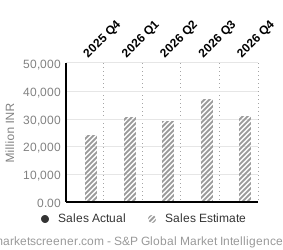
- Revenue: ₹3,140.3 crore (↑ 21% YoY)
- EBITDA: ₹459 crore (↑ 25.6% YoY)
- EBITDA Margin: 14.6% (↑ 60 basis points YoY)
- Net Profit: ₹206 crore (↑ 37.3% YoY)
- Same Store Sales Growth: 10.5%
Despite higher employee costs and expenses, margins expanded. The company is clearly improving its efficiency at scale.
The share price reflects this confidence – nearly doubling since its IPO price of ₹78. Over the past six months, Vishal Mega Mart share price has risen 42.7%, while over the past year, it’s up 31%.
Competitive Edge of Vishal Mega Mart Share
What makes Vishal Mega Mart different from DMart and others?
1. Affordable Pricing
The company follows a value-first strategy, appealing to India’s middle- and lower-middle-income families.
2. Presence in Tier 2 and 3 Cities
Unlike DMart, which is heavily concentrated in metros, Vishal Mega Mart is aggressively expanding in smaller cities where organised retail penetration is low.
3. Strong Private Label Focus
With 26 in-house brands across apparel, FMCG, and merchandise, private labels contributed 73% of FY24 revenue. Out of these, 19 brands crossed ₹100 crore in sales.
4. Quick Commerce Initiative
The company has already taken steps into quick commerce with 670 stores across 445 cities, serving 9.8 million registered users.
5. Store-Level Profitability
Vishal Mega Mart has demonstrated high RoCE, strong unit economics, and a quick payback cycle, making expansion self-funded and sustainable.
DMart vs Vishal Mega Mart Share
Here’s a comparison of both retail giants:
| Metric | DMart | Vishal Mega Mart |
|---|---|---|
| Current Share Price | ₹4,358 | ₹147 |
| Store Count (2025) | 383 | 717 |
| Revenue Segments | FMCG heavy | Apparel heavy |
| City Focus | Tier 1 | Tier 2 & 3 |
| Private Labels | Moderate | Very High (73%) |
Key takeaway:
DMart dominates metros with its grocery-led model. Vishal Mega Mart dominates smaller cities with apparel and merchandise. The growth opportunities in Bharat (Tier 2 & 3 India) are massive, and VMM is positioning itself strongly.
Stock Market Momentum
Inclusion in the MSCI Standard Index has been a big milestone. Analysts expect inflows worth $258 million due to passive index funds.
Brokerages are bullish too. Motilal Oswal recently gave a “Buy” rating with a target price of ₹165, implying an upside from current levels. (Source: The Economic Times)
The rising institutional interest is also notable. As of June 2025:
- FIIs increased their stake from 7.03% to 12.85%.
- DIIs nearly doubled their stake from 12.18% to 27.25%.
- Mutual funds alone hold 25.69% of the stock.
This shift shows growing confidence in the long-term story of Vishal Mega Mart share.
Challenges Ahead
While the growth story is promising, risks remain:
- High competition from Reliance Retail, DMart, and online players.
- Apparel-heavy model could be more cyclical compared to grocery-focused DMart.
- Valuations are already rich, with a P/E ratio of 99.31.
Investors need to track execution carefully.
Quarterly revenue – Rate of surprise
Conclusion – Can Vishal Mega Mart Become the Next DMart?
The answer depends on how you define “next DMart.”
If it means dominating Tier 1 grocery retail, then no. That’s DMart’s turf.
But if it means capturing Bharat with affordable fashion, merchandise, and FMCG, then Vishal Mega Mart could indeed become a parallel success story.
At ₹147, Vishal Mega Mart share offers investors a chance to ride India’s Tier 2 and 3 consumption boom.
DMart built its empire on cities. Vishal Mega Mart is building its empire on Bharat. And Bharat is rising.
That’s all for today’s post. Hope you get some valuable insights from here.
Happy reading!
Disclaimer
The blog is meant for informational purposes and serves the general analysis of the stocks. The contents provided here are based on careful research and analysis utilizing the fundamental and technical indicators over a while. The post does not have any direct recommendations about investing or trading in the securities market. Thorough research and careful consideration are necessary for individuals to fulfill their responsibility in making financial decisions. Seeking professional advice before making any financial decisions is always advisable.